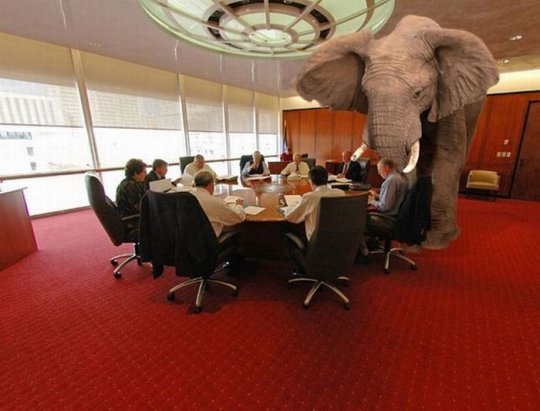
This Wall Street Journal article sheds light on why corporate leaders have to be physically fit in order to accomplish their roles.
Being fit matters.
New research suggests that a few extra pounds or a slightly larger waistline affects an executive's perceived leadership ability as well as stamina on the job.
While marathon training and predawn workouts aren't explicitly part of a senior manager's job description, leadership experts and executive recruiters say that staying trim is now virtually required for anyone on track for the corner office.
"Because the demands of leadership can be quite strenuous, the physical aspects are just as important as everything else," says Sharon McDowell-Larsen, an exercise physiologist who runs an executive-fitness program for the nonprofit Center for Creative Leadership.
Executives with larger waistlines and higher body-mass-index readings tend to be perceived as less effective in the workplace, both in performance and interpersonal relationships, according to data compiled by CCL. BMI, a common measure of body fat, is based on height and weight.
While weight remains a taboo conversation topic in the workplace, it's hard to overlook. A heavy executive is judged to be less capable because of assumptions about how weight affects health and stamina, says Barry Posner, a leadership professor at Santa Clara University's Leavey School of Business. He says he can't name a single overweight Fortune 500 CEO. "We have stereotypes about fat," he adds, "so when we see a senior executive who's overweight, our initial reaction isn't positive."
CL staff detected the correlation after collecting hundreds of peer-performance reviews and health-screening results from the CEOs and other senior-level managers who participate in its weeklong leadership workshops in Colorado Springs. A pair of university researchers, using data from 757 executives measured between 2006 and 2010, found that weight may indeed influence perceptions of leaders among subordinates, peers and superiors.
Tim McNair, a general manager at Nazareth, Pa.-based guitar maker C.F. Martin & Co., says he was inspired to make some changes after spotting his "gut" on camera during a recent public-speaking exercise while attending the CCL workshop.
He wondered whether his colleagues had the same reaction to his appearance, he says, adding: "Would they think, 'If he can't keep his hand out of the cookie jar, how can he do his job?'"
So the 44-year-old, who says his peers' evaluations were somewhat harsh, recently rejoined the local gym, where he heads after work at least three days a week to run on the treadmill, cycle or stretch. He has also given up double cheeseburgers, steak, ice cream, Coca-Cola and Tastykakes, opting for a healthier diet of grains and vegetables. In four months, he has shed about 25 pounds.
The fitness imperative for executives is relatively new, says Ana Dutra, the CEO of Korn/Ferry Leadership and Talent Consulting. Time was, a company chief spent every waking minute at work, sacrificing exercise, vacation and kids' soccer games in the service of the firm. Employees were expected to admire and emulate this devotion. Now, executives are expected to take time off to "revitalize themselves," Ms. Dutra says.
She pegs the shift to the sudden deaths of high-profile CEOs, including McDonald's Corp. MCD +0.65% chief Jim Cantalupo, who died of a heart attack in 2004, 16 months after taking the post. His successor, Charlie Bell, died less than a year later of cancer at the age of 44. In 1997, Coca-Cola Co. Chairman Roberto Goizueta, a smoker, died weeks after being diagnosed with lung cancer.
The CEOs of today are also more visible than their forebears and must be camera-ready at a moment's notice, composed while courting investors and ready to respond in a company emergency. Excess weight can convey weakness or a "lack of control," says Amanda Sanders, a New York-based image consultant who has worked with senior executives at Fortune 500 firms.
"It's the leadership image you project," says Mark Donnison, 47, a senior executive director at Canadian Blood Services who has lost 25 pounds since starting an early-morning workout rotation of cardio, weights and yoga last summer. "Folks do see how you live."
Companies seek leaders with physical endurance, the better to manage global businesses and solve complex problems, says Mr. Posner, who advised Dow Chemical Co. DOW -6.96% on training high-potential global leaders in 2010 and 2011. Those leaders were instructed to build in regular time for exercise to help them withstand the constant travel and the demands of an overseas role. The training even incorporated such classes as Zumba, Pilates, tai chi and yoga, says Dawn Baker, Dow's global director of talent management.
Panera Bread Co. PNRA +1.02% founder and co-CEO Ron Shaich says he began working with a trainer about five years ago, in part to stay energized while running a growing company. Two to three times a week, he gets up for a 5:30 a.m. appointment with his trainer, and on Sundays he opts for a 90-minute run. The workouts have boosted his energy levels and helped him focus, he says.
In general, the executives in the Center for Creative Leadership study were healthier than the average American. They drank and smoked less and were more likely to exercise regularly. About half were considered overweight or obese, defined as having a BMI of more than 25. By contrast, more than 60% of Americans fit this description, according to a Gallup-Healthways Well-Being Index last year.
The sample's leaner executives, defined as having a BMI under 25, were viewed more favorably by peers, averaging 3.92 for task performance on a five-point scale; heavier leaders averaged 3.85. Similarly, members of the leaner group rated higher on interpersonal skills.
The study controlled for factors such as age, race, gender, job level and personality traits. Results were similar across industries, says Eden King, one of the study's researchers and an associate professor of psychology at George Mason University.
To be sure, the perception of competence isn't the same as measurable leadership success. Executives who were part of the study say it's difficult to say how much of the perceived bias stems from their physical weight and how much from their own projected insecurity.
Weight Watchers International Inc. WTW -0.98% CEO David Kirchhoff, 46, recalls feeling painfully self-conscious when his weight was at its peak a decade ago, around the time he first took up the post. At six-foot-two and 245 pounds, he tried to hide his girth with oversize sweaters and pleated pants.
"I sucked in my gut a lot," says Mr. Kirchhoff, who has since lost 40 pounds. Now, he says, "I probably carry myself with more confidence and authority.
This Marc Accetta Facebook page contains articles about successful leadership and other business aspects.